Level 8 - Advanced Moves
Special Moves
Self-Connecting Priority
- If a player has two playable cards, one of which connects to their own hand and the other doesn't connect to anything, playing the connecting card is often better.
- Thus, playing the non-connecting card is a Priority Prompt on the rightmost card that could reasonably be the connecting card, or a Priority Finesse/Bluff on the leftmost unclued card.
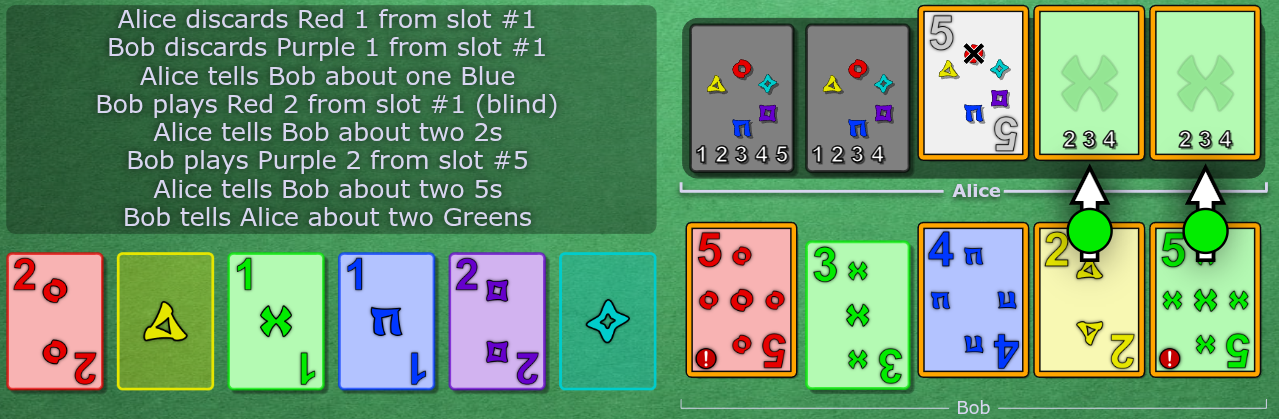
In the following example, Alice's y4 is clued only with yellow.
Conventions
Quasi-Locked
- If Alice is given a Referential Discard Clue while Bob has a safe action (including PTD), she can stall by giving a Fill-In Clue on a previously-unknown playable or a direct colour clue (focusing leftmost). This is not additionally referential.
- If Bob plays the new card, it is treated as Unlock Promise on Alice. Otherwise, Bob should perform their previously-known action.
- The highest priority target for unlock is the card called to discard, otherwise the rightmost possible connector.
- If unlocking the rightmost possible connector, the Referential Discard Clue does not get revoked.
- This prevents the situation where Alice is forced to discard a 1-away card that connects through an unknown card in Bob's hand.
- This convention can only be performed immediately after Alice receives the Referential Discard Clue. If Bob declines to unlock, this convention no longer applies.
- In rainbowish variants, Colour Truth applies.
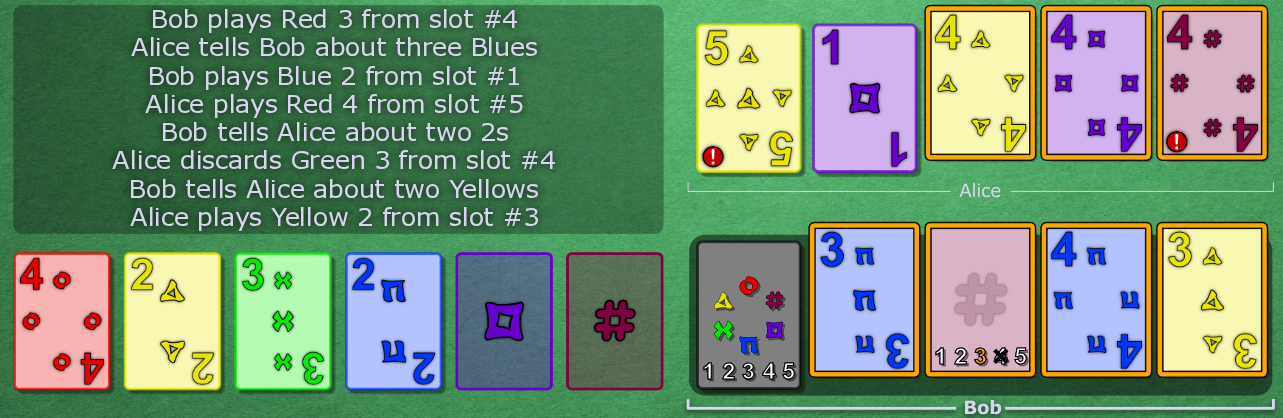
In the following example, Alice has previously told Bob's slot 2 to discard. Alice also has PTD in slot 1.