Level 5 - Exceptional Situations
Stalling Situations
- A player is in a stalling situation if they are forced to give a clue. Examples of stalling situations include:
- Turn 1
- Locked
- At 8 clues
There are special rules around being Locked that are covered in level 4.
Starting Hand Stalls
- On turn 1, if Alice clues a rank clue touching slot 5, this is a Starting Hand Stall and Bob is forced into a stalling situation.
- If Alice doesn't immediately follow up with another clue, Bob has Permission to Discard his leftmost unclued card.
- This does not apply if Alice clues a Playable Rank Clue, such as 1.
Rank Stalls
- Reclues and Lock Clues are interpreted as stalls (i.e. no meaning).
- Playable Rank Clues and Referential Discard Clues are interpreted as if the player was not stalling.
- Loaded Rank Play Clues are interpreted as Referential Discard Clues.
Every other clue is interpreted as if the player was not stalling.
7-After-8 Stalls
- Immediately after Alice stalls at 8 clues, Bob may also stall as a 7-After-8 Stall to prevent the team from going back to 8 clues.
- Bob is not forced to give a 7-After-8 Stall, and there are situations where it would be disadvantageous to do so.
- e.g. if Alice is locked, if Alice's clue revealed a play, or if Bob is likely to discard trash, Bob should not give a 7-After-8 Stall.
Emergency Situations
Zero Clue Safety Promise
- When Alice uses the last clue, she promises a safe discard in Bob's hand, referred to as ZCSP.
- From highest to lowest priority, the possible targets are:
- Known trash, including cards Called To Discard
- Leftmost unclued and not Chop Moved (most clues CM slot 1, so this is often slot 2; see below for an example).
- Least likely to be critical (can be a clued card)
- A card with ZCSP is considered to be known trash. Thus, the player is Loaded until it is discarded, even if it is a clued card.
- From highest to lowest priority, the possible targets are:
- If all of Bob's cards are critical, Bob is not promised a safe discard.
- This is a very dangerous situation, and if Alice is unable to give Bob an Extra Discard as shown below, Bob should use his best judgement in deciding what to discard (likely the newest drawn card).
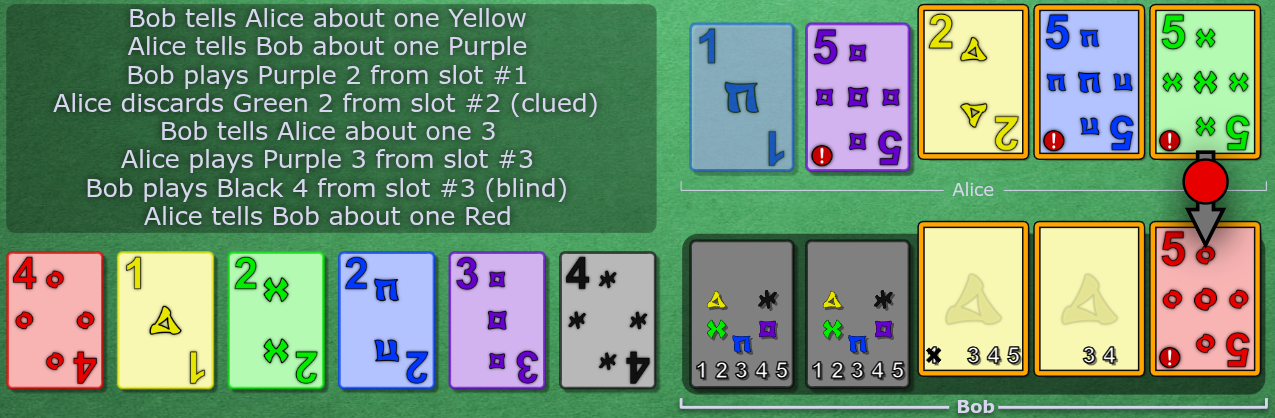
Zero Clue Free Choice Extra Discard
- At 0 clues, if Alice can choose between regaining a clue and not, staying at 0 clues promises Bob's slot 1 to be trash as an Extra Discard.
- As a corollary, gaining a clue (by discarding or playing a 5) causes a Chop Move on slot 1.
- If Alice can only choose between playing a 5 or discarding, playing the 5 promises Bob's slot 1 to be trash.
- Giving Bob an Extra Discard may allow Bob to have Free Choice to give Alice an Extra Discard as well.
- If the clue count is above 0, choosing to play over discard has no extra meaning.
In the example in the previous section, since Bob can discard ZCSP in slot 2, playing r5 would give Alice an Extra Discard in slot 1.
- Normally, Alice's slot 1 would be automatically sieved after Alice plays her known y2.
Bomb Lock
- Bombing known trash (including PTD or ZCSP) locks the other player.
Scream Lock
- Discarding chop or known trash while having a globally known playable (outside of SDCMs at 0 clues) locks the other player.
Sacrifice Unlock
- Sacrificing a card to unlock yourself can only be done immediately after being locked. This does not promise a Baton or Gentleman's Discard.
- Occasionally, the team's best discard is an uncritical 4 in the locked player's hand. This would be a good time to perform a Sacrifice Unlock.
Sacrifice Scream Lock
- If a Sacrifice Discard is performed multiple turns after being locked, this locks the other player.
Rationale
-
Teams often reach 8 clues when Bob discards at 7 clues and gives Alice PTD on slot 1.
- If Alice is forced to give a Referential Discard Clue since Bob has no playables, Bob may be asked to discard a useful card.
- The 7-After-8 Stall allows Bob to "pass" the turn back to Alice to discard her safe PTD first before making further decisions.
-
Because we don't have information about future chops, it's possible that saving one card can lead to additional criticals or 5s being drawn after discarding.
- Thus, it's often better to lock a hand with low, useful cards like 3s and 4s than to save individual cards and potentially end up drawing high, critical cards.
- The multiple ways to lock above facilitate these techniques while maintaining a healthy clue count.