- A clue that touches no new cards is called a reclue. A reclue that reveals a playable or trash card has no additional meaning.
- If no safe action is revealed, such a clue intends the focused card to be playable, promising other playable cards in the hand.
- The Focus of a reclue is the leftmost touched card.
Special Moves
The Prompt
- When there are clued cards that could connect to the card, the rightmost such card is promised to connect.
- Connecting cards can match in either rank or colour.
- This is called a Prompt, since it is like the card is being "prompted" to play.
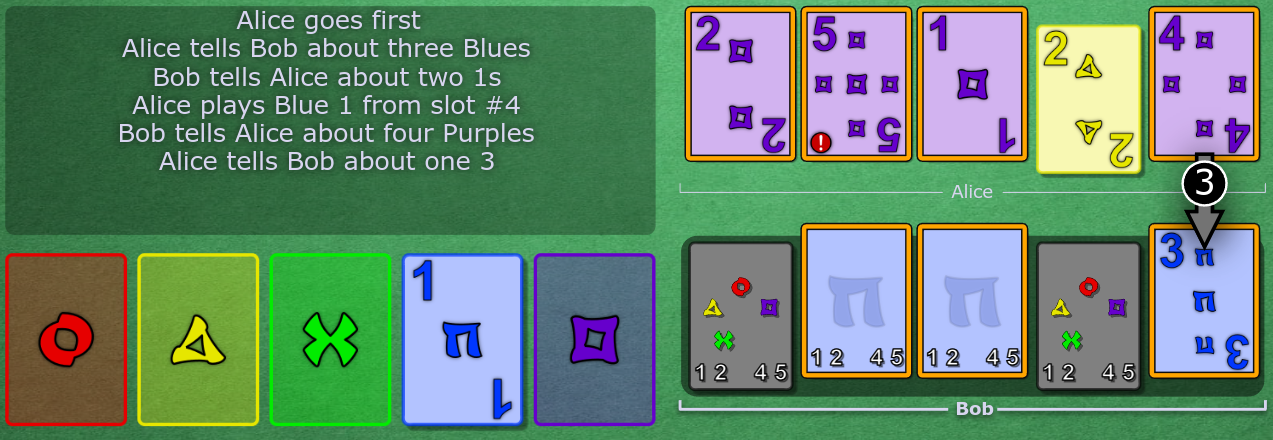 Alice is prompting Bob's slot 3 to play as b2.
The Finesse
- If there are no clued cards that could connect, the leftmost unclued card (usually slot 1) is promised to connect.
- This is called a Finesse, like the term in bridge.
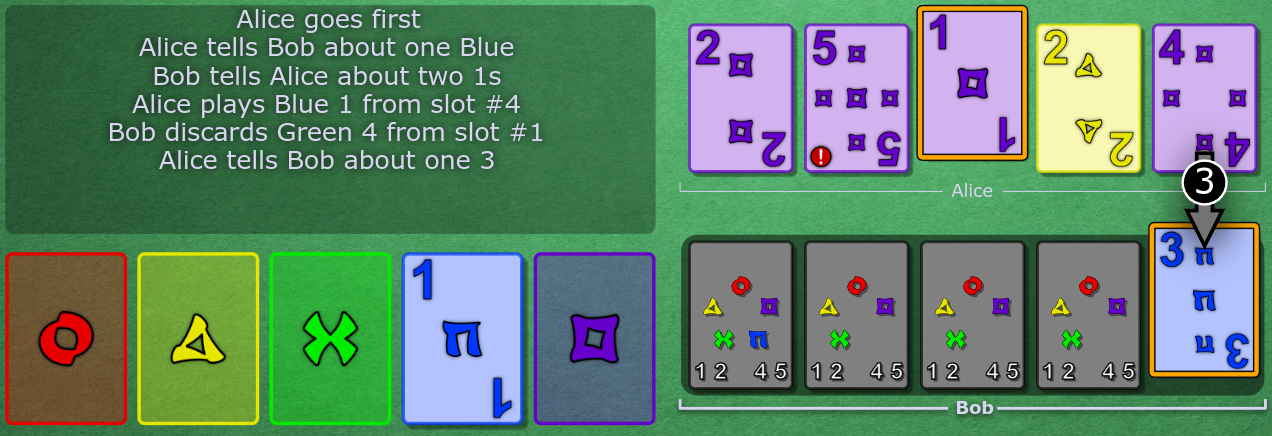 Alice is finessing Bob's slot 1 to play as b2.
The Bluff
- The blind-played card doesn't need to actually connect to the Focus in a Finesse, as long as it is playable.
- If the card does not connect, this is known as a Bluff.
- After the blind play of an unconnected card, the receiver will know that a Bluff occurred and stop playing.
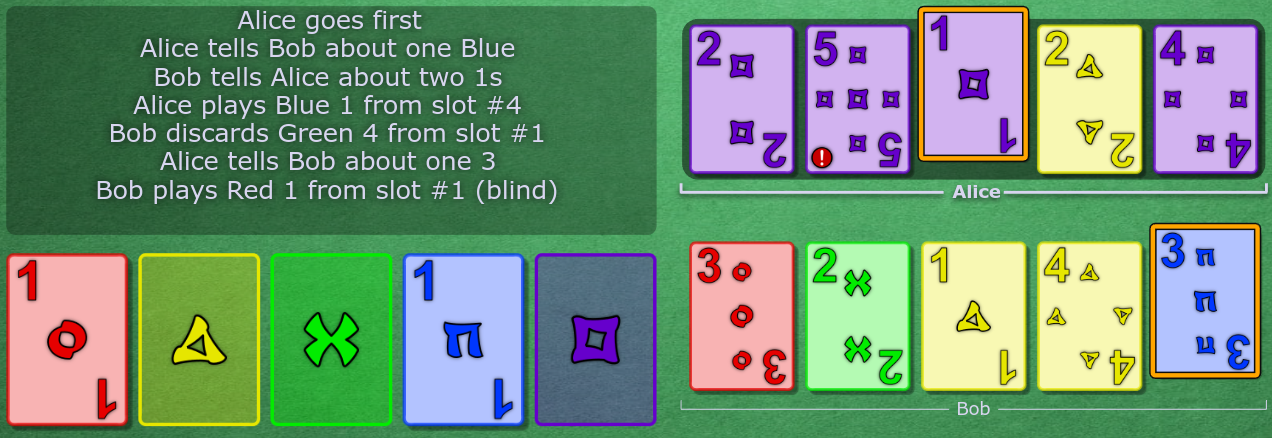 Alice Bluffed Bob's slot 1, getting r1 to play. Bob is not promised b2 anywhere.
The No-Info Double Bluff
- If a reclue is given that does not fill in the focused card (gives no new information), this is very strange.
- Normally, a clue is used to fully reveal the card, so the receiver can tell if it's playable, trash, or needs connecting cards.
- But since this clue is so useless, it gets the two leftmost unclued cards to play as a Double Bluff.
- Nothing is promised about the focus.
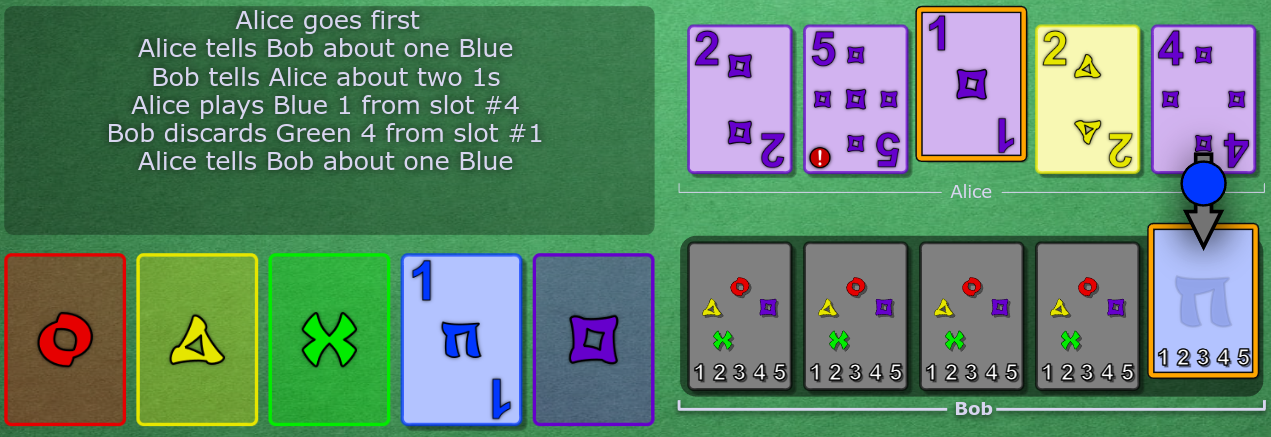 Alice intends to Double Bluff Bob's slot 1 and slot 2.
- A No-Info Double Bluff can be performed on cards that are already fully known, even known trash.
- The only requirement is that the clue gives no new information about any of the touched cards.
Conventions
Precedence Between Prompts and Finesses
- If the focus is more than 1-away from playable, it is ambiguous whether to play into a Prompt or a Finesse.
- If it is possible that no Finesses are required, only Prompts, then this is the preferred interpretation.
- If at least one blind play would be required, it should be performed first.
- If the blind-played card doesn't connect, this becomes a Bluff and the receiver isn't promised anything else.
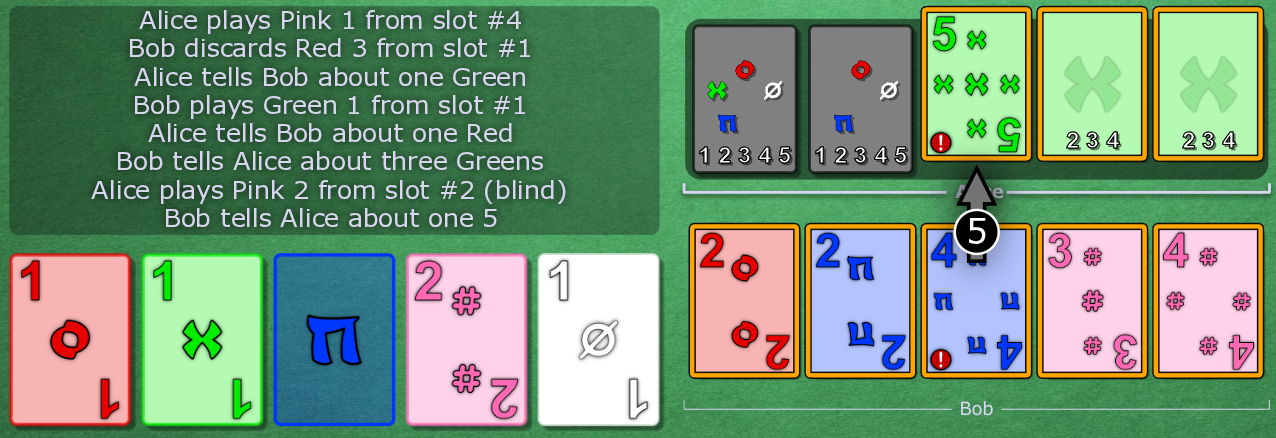 Since 1 blind play is required, Alice should play slot 1 first. She is promised g4 in slot 4 and g3 in slot 5 only if slot 1 is g2.
Differentiating a Bluff and a Finesse
- If more than 1 blind play would be required, it is always a Bluff.
- Otherwise, it is only a Finesse if the blind-played card could connect to the focused card.