Level 3 - Loaded Situations
Special Moves
Loaded Clues
- A player is Loaded if they have a safe action.
- If a player has more than one safe action, some of the cards they draw will never be on chop.
- Those cards will be "automatically sieved" as the player performs their safe actions.
- Thus, cluing Loaded players is low-value, since they'll have more than one safe action and may sieve trash into their hand.
Loaded Rank Play Clues
- A Loaded player will never discard their chop, so it doesn't make sense to give them a Referential Discard Clue.
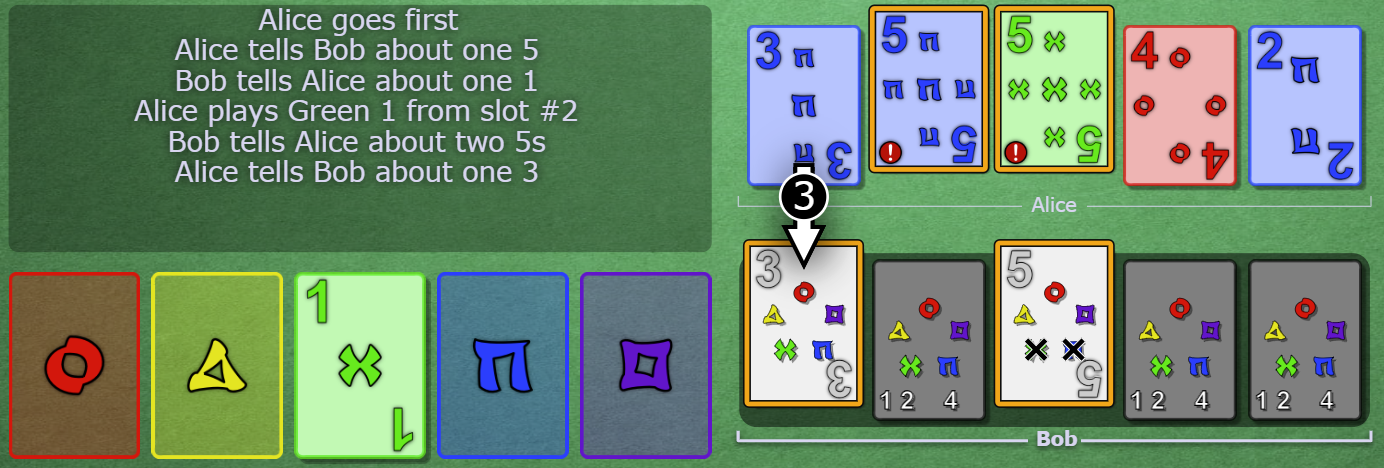
- A rank clue while loaded is instead a signal to play the card to the right of the newly-clued cards.
- The rank must not be known trash, otherwise it becomes a Trash Push (see below).
When multiple cards are clued,
- The Focus of the clue is the rightmost newly-clued card, but the rightmost previously-unclued card has lowest precedence.
- The Target of the clue is the previously-unclued card to its right, wrapping around if necessary.
This works in essentially the same way as a Referential Play Clue, but toward the right instead of the left.
In the following example, Bob was previously given a Referential Discard Clue targeting slot 4.
Loaded Colour Clues
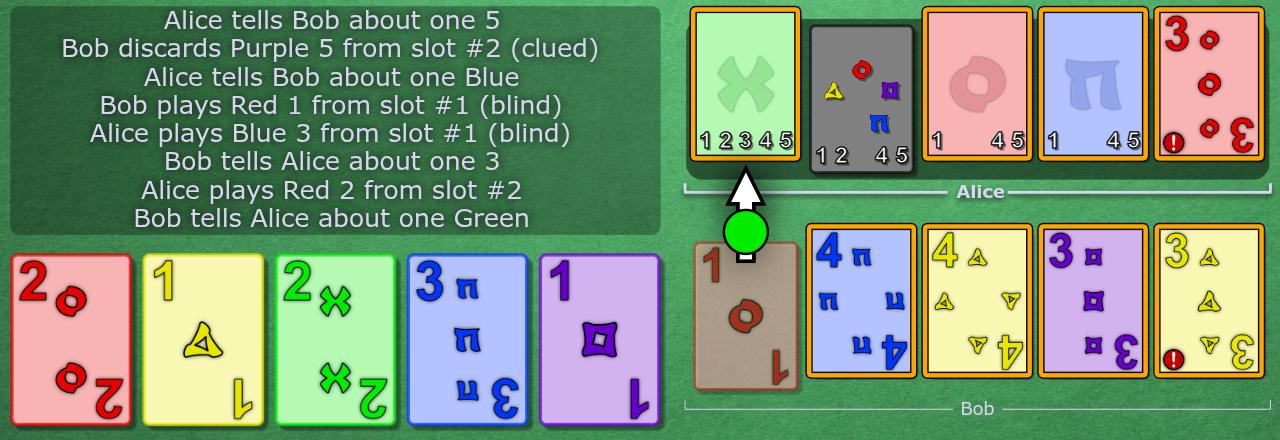
- The meaning of a loaded colour clue depends on what the player is loaded on.
- If they are loaded on only discards, then a colour clue is a normal Referential Play Clue.
- Otherwise they are loaded on at least one play, and a colour clue is a Direct Play Clue on the leftmost newly-clued card.
- The colour must not be known trash, otherwise it becomes a Trash Push (see below).
Trash Push
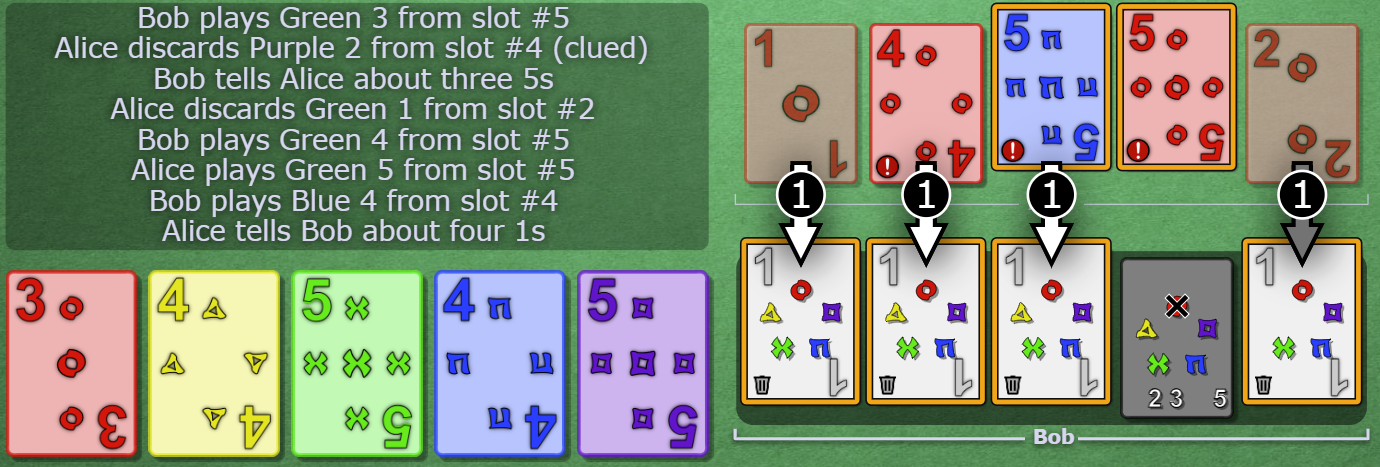
- A clue that touches only known trash is a Trash Push. This has higher precedence than a Loaded Rank Play Clue.
- This is interpreted as if a colour clue was given touching the same cards, as a Referential Play Clue.
- If the targeted card is clearly unplayable, the target shifts left (with wraparound) until reaching a potentially playable card.
Conventions
Hard Permission to Discard
- When a card receives Permission to Discard, it is considered to be known trash. Discarding a card with PTD is thus a safe action, and a player that has a card with PTD is Loaded.
- They can receive Loaded Rank Play Clues, and they do not have a chop until the card with PTD is discarded.
- Both players need to keep track of everyone's safe actions in order to determine which cards have PTD and when someone becomes Loaded.
- Importantly, PTD notes are not removed even after a card moves off chop.
- It helps to keep track of the card that has PTD by writing a note of
[ptd]on it.
Revoking PTD
- If necessary, PTD can be revoked by cluing the card directly. This can occur due to double discard situations, for example.
- Such a clue should be interpreted as if the player did not previously have PTD.
- Level 7+ players have another way to revoke PTD.
Chop Moves
- If a card is intentionally sieved in and doesn't receive PTD, the card must be important.
- This can be noted using a note of
[cm], which stands for Chop Move. - Chop Moved cards are not special: the note is purely for personal information and such cards can still be targeted by Referential Discard Clues.
- This is different from H-Group, where cards that have been Chop Moved are no longer eligible to be discarded.